

AgTech Garage celebrates 5 years leading the 4th era of innovation, the “corporate garages” one
José Tomé, CEO of AgTech Garage, shares the references behind the creation of the hub and his vision for the future to continue innovating agribusiness
Junho 1, 2022
By José Tomé
The year was 2012 and I had already started to study about open innovation when I read the article by consultant Scott D. Anthony, of Innosight, in MIT Technology Review. He said that we could be facing the "new era of corporate garages", or the so called 4th era of innovation.
Before it, the 1st era of innovation had been based on the solo entrepreneur, or rather, on the inventor, whether it was Thomas Edison with the light bulb; Whitney with the cotton mill or even Santos Dumont with his airplane. Then 2nd era of innovation was the R&D one, of laboratory experiments, when the responsibility to innovate passed from the individual to the companies, but each one in its own square. In this context, it didn't take long for the bureaucracy to end up making room for 3rd era of innovation, when startups and Venture Capitals began to emerge and disrupt consolidated markets. This is the age of Apple, Microsoft, Google, etc.
There, we already had a sign that the dynamics of innovation was changing, which is why Anthony proposed in this MIT Technology Review article the history of "corporate garages". The idea inspired the name of the AgTech Garage — which was officially born in 2017, when the 4th era of innovation was still in its infancy. According to Anthony, corporate innovation catalysts were beginning to have a transformative impact, instilling the spirit of startups in giants like IBM.
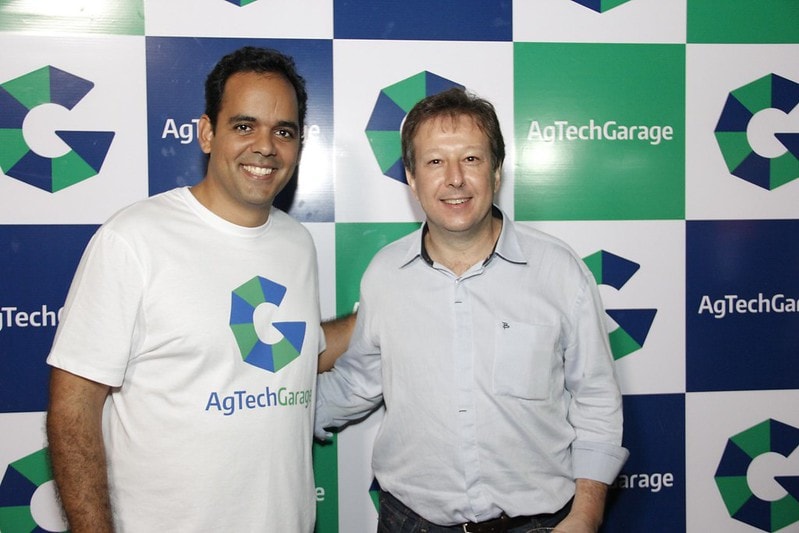
José Tomé (left) and Marcelo Carvalho (right) at the AgTech Garage Day, the hub co-founders
The agribusiness corporate garage
Me, Adriana and Marcelo — co-founders at AgTech Garage — have always been very clear about our position of creating something for big companies, which would consequently also help entrepreneurs. The idea was that companies would actually be able to practice open innovation.
Anthony's article explains that "garage" is where great things were created back in the day. But I believe that today's garages are no longer like they used to be. From now on, we will no longer see startups coming out of isolated garages as it was in the past. They will come out of hubs like the AgTech Garage, as well as the big innovation projects of companies. Our garage is multistakeholder, so the corporate, the startup, Academia, and also the rural producer participate in it, because we were born with a theme. Our theme is agtech or, more precisely, the agribusiness value chain, from farm to fork.
It is interesting to realize that we were one of the first in Brazil to introduce this concept. A while later, other garages appeared. For example, the BNDES Garagem and Garagem AgroStart, from BASF. Microsoft already had The Microsoft Garage outside Brazil. In addition to the article that opens this text, we looked for several other references and took a trip to the United States in 2016 to learn about different innovation initiatives. We visited accelerators, such as Plug and Play and Thrive, and the Western Growers Center for Innovation & Technology ag hub. We visited The Yield Lab investment fund. The objective was not to copy and paste what existed abroad and bring it to Brazil. In fact, we went to gather inputs to build our own model. We went to observe and learn. Meanwhile, we talked a lot with companies in Brazil to understand what would make sense for them.

The AgTech Garage headquarters, an environment that encourages new connections
AgTech Garage was launched in 2017, and in 2016 Startup Genome, which lists the main entrepreneurship ecosystems in the world, began to consider the role of large companies in the ecosystem for the first time. They have always done various assessments to understand and make it very clear why Silicon Valley is Silicon Valley, looking at access to capital, to talent. And finally, they asked: Does Silicon Valley have a reasonable number of companies in the ecosystem? Yes, it did, and that was a positive point for us. In fact, I was very impressed by the inclusion of this criterion "participation of large companies" in Startup Genome to build the AgTech Garage. It was yet another fact sheet that confirmed the need for the participation of large companies in the innovation ecosystem, which was lacking in Brazil.
In this research process, already with the AgTech Garage brand in hand, we also did the first agribusiness startup sense together with Esalq-USP. At that moment, we already asked the entrepreneur: What are your challenges? How do you see the relationship with big companies? This also served as input for us to create our model. There was still very little in Brazil... Pulse, Raízen's innovation hub, for example, was born in 2016, and then it was interesting to follow a different national case. It turned on another light of: "It's real, companies are going that way."

José Tomé (left) and Adriana Lúcia da Silva (first from right) with members of EsalqTec
On the other hand, from the very beginning, our proposal was to attract several partners closer. We understood back then the importance of density to foster a broad community and position ourselves in the innovation ecosystem worldwide. We therefore adopted a multistakeholder model, dividing the risk among several companies, with each one investing a smaller ticket to be part of our network and being nourished by the diversity of the surrounding environment. The emergence of the AgTech Valley, the Piracicaba Valley, was yet another element that came to position the ongoing movement in the Brazilian agribusiness innovation scene.
Innovation as a strategic area for companies
In these last five years, our essence has been maintained and we are maturing our practices. Once we decided to help big companies and generate benefit for the entire ecosystem, we leveraged our way of doing open innovation. Today, with experience, best practices, tools, and specialized professionals, we help companies with their innovation management.

Partners Connection 2022 held at the Piracicaba Valley Technology Park
When we started, many companies said: "We do innovation organically". Today, it's pretty clear that this is a very professional industry. We generate value for companies in a structured way and include in the list all the other spheres that make up the agribusiness innovation ecosystem, that is, the ag&food techs, professors and researchers, consultancies, international agencies and the rural producers — which we defend to be at the center of innovation in the sector. Today, anyone looking from the outside can see how much value we generate for all these agents, especially startups, even though our core business is more related to the corporate partners (Innovation and Ecosystem Partners). The relevance of startups to the innovation ecosystem is reflected in our purpose. We are also here to "feed the entrepreneurs who will feed the world."
If, before, innovating could be something organic, nowadays, the importance given to this topic is so big that innovation is treated by the leadership of organizations at the corporate-strategic level. In other words, looking at how open innovation can impact all departments of the company, from people management to marketing, and not just the business area. Innovation governance is already being implemented in most of AgTech Garage's 87 corporate partners, with different stages of maturity.
Next steps
Looking back, there is no doubt in my mind that we created a unique model that generates value for everyone involved in the innovation ecosystem, and a very solid network of partners. The AgTech Garage community currently has over 80 companies, over 1,000 startups on our virtual platform and over 100 resident and membership startups, as well as hundreds of partner universities and research institutions and 30 connected international agencies.
I am proud to hear from our partners and future entrants that "it is not possible to hold an innovation event in agri sector without the presence of the AgTech Garage" and that "there is no way to want to invest in open innovation in ag&food tech without knowing the value proposition of AgTech Garage." This market positioning, this relevance, this recognition that we have is our main achievement in these five years, in addition to a team supported by a culture of a lot of learning and reinvention, which should have almost 60 professionals by the end of 2022. AgTech Garage was elected in 2021 as one of the 20 main articulators of the innovation ecosystem in Brazil, the only one in agribusiness. We created something that is sustainable and that is having a positive impact.
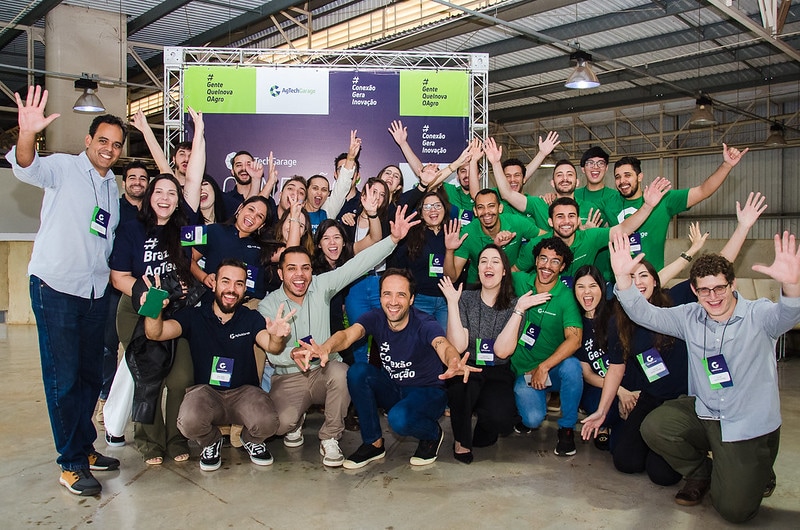
Part of our team at Partners Connection 2022, a team of people who do the difference
And, although we have already done a lot, the feeling is that we are just at the beginning of our journey. We see a world of opportunities just ahead. We expect to grow six times over the next three years, consolidating new initiatives we have at AgTech Garage, such as For Farmers and Flagship. Flag is an initiative that we are very excited about and has everything to be very disruptive. It is about distributing the hub, which was something designed by many to be the center, and we are proposing the opposite. We aim to expand our impact, to take the AgTech Garage experience to partner hubs, and to make open innovation reach more and more people, including outside of Latin America. We will consolidate ourselves as a global network, connecting the ag&food tech ecosystem in a genuine way.
Since November 2022, AgTech Garage became part of PwC network, starting a new great chapter in our history.

José Tomé, co-founder and CEO of AgTech Garage
Contatos